
Collection: Reagents
BioSystems’ reagents are manufactured under stringent quality standards and have a long shelf life, so you can make full use of your quality control investment. BioSystems offers more than 30 enzymatic and colorimetric kits for organic acids, sugars, sulfites, phenolics, and more.
With dependable lot-to-lot consistency and compatibility with supported analyzers, these reagents help labs maintain confidence in their results while improving operational efficiency. In addition to AOAC, ISO and OIV validation, BioSystems’ kits are validated with reference laboratories around the world as well as with in-house QC validation.
-
MultiReference
 Multi parameter quality control Kit volume: 2 x 10ml Acetic Acid, Ammonia, Citric Acid, D-Gluconic Acid, D-Glucose, D-Glucose/D-Fructose, Glycerol, D=Lactic Acid, L-Lactic Acid, Primary Amino Nitrogen, Sucrose/D-Glucose/D-fructose, L-Malic Acid. (12 total tests) Info + Purchase
 -
Catechins, reagent kit for wine
 Catechins reduce and prevent anthocyanin oxidation, keeping them from being precipitated. They are also responsible for the bitterness, astringency, yellow hue, structure and stability of the wine. When catechins are polymerized, they form procyanidins that gradually form complexes with proteins, peptides and polysaccharides. Info + Purchase
 -
Acetaldehyde, Reagent Kit for Wine and Beer
 Acetaldehyde is one of the components of the oxidative chain of alcoholic fermentation. Acetaldehyde is also formed in the wine aging process by ethanol oxidation. Acetaldehyde concentration is closely related to SO2 content. This combination is responsible for antioxidant activity. Info + Purchase
 -
Total Acidity, Y200 / Y400 and Spica format, reagent kit for wine, kombucha and cider
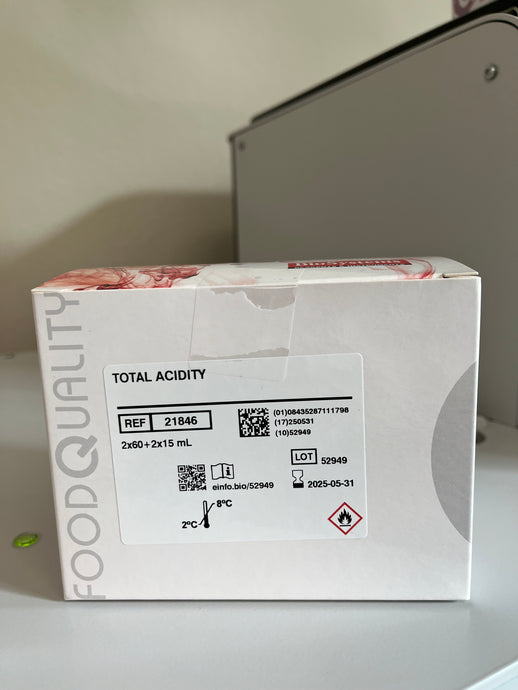 Determining the total acidity in the must guarantees good fermentation, it is also desired in wine since it is a key factor for conservation, stability of wine over time and also plays a very important role important in the balance and mouthfeel of wine. Info + Purchase
 -
Polyphenols
 Phenol components significantly enhance the antioxidant properties, color and mouthfeel of red wines. The importance of these phenol components in sensory perception requires assay at all stages of the winemaking process. Info + Purchase
 -
Control Wine, White
 Control Wine (white and red) is a wine (10 x 5 ml) that contains various components at adequate concentrations for quality control in laboratories. The product is designed for intra-laboratory quality control and is supplied with acceptable value intervals. Info + Purchase
 -
Ammonia, Y200 / Y400 and Spica format, reagent kit for wine, kombucha and cider

Enzymatic method for ammonia determination
- Kit volume: 150 ml
- Method: Two-reagent differential at 340 nm
- Limit of linearity: 200 ml/l
- Limit of detection: 3.0 mg/l (ppm)
Advantages
- Stable liquid reagent until the expiration date
- Ready-to-use dedicated reagent
- Liquid calibrator included in the kit
Low nitrogen levels have been related to slow fermentation or sulfide production. Conversely, high levels can lead to micro- bial instability and production of ethyl carbonate.
Info + Purchase -
Primary Amino Nitrogen (PAN), Y200 / Y400 and Spica format, reagent kit for wine, kombucha and cider
 Nitrogen compounds (molecules containing a primary amine nitrogen) in must and wine play a key role in fermentation and the potential of microbial stability. Info + Purchase
 -
Copper, reagent kit for wine
 Copper is a metal that clearly originates in the process of vinegrowing. The main source is phytosanitary treatments of vineyards to prevent mildew. During harvest, the copper content may be 4 to 6 mg/L. During fermentation its concentration decreases to 0.2-0.3 mg/L due to the formation of copper sulfides or the presence of yeasts that fix the copper contained in the medium.The OIV has set a maximum acceptable limit of copper of 1 mg/L. Info + Purchase
 -
Anthocyanins, reagent kit for wine
 Anthocyanins are the tinted pigments in grapes, with the word coming from the Greek root “antos” (flower) and “kyanos” (blue). These pigments are found in both the skin and the pulp. Info + Purchase
 -
Calcium
 Calcium is present in wine at concentrations of 6 to 165 mg/L. Instability due to calcium tartrate appears at 4 to 7 months of fermentation. Info + Purchase
 -
Sorbic Acid, reagent kit for Y15/Y25

Colorimetric analysis for sorbic acid determination
- Kit volume: 150 ml
- Method: Kynetic monoreagent, reading at 520 nm
- Limit of linearity: 300 mg/l
- Limit of detection: 2.19 mg/l (ppm)
Advantages
- Stable liquid reagent until the expiration date
- Liquid calibrator included in the kit
Sorbic Acid is a natural organic compound used as a food preservative in its mineral salt form (Potassium sorbat). The maximum limit permitted by OIV in wine for sorbic acid is 200 mg/l. Sorbic acid inhibits with SO2 yeast populations in pre-bottled wine and it is used to avoid undesired fermentations in wine bottles, especially in off-dry and sweet wines.
Sorbic acid is oxidized to obtain malondialdehyde (MD) that reacts with thiobarbituric acid (TBA) generating a compound that can be measured spectrophotometrically.
Info + Purchase


- Previous page
- Page 3 of 5
- Next page