
Collection: Reagents
BioSystems’ reagents are manufactured under stringent quality standards and have a long shelf life, so you can make full use of your quality control investment. BioSystems offers more than 30 enzymatic and colorimetric kits for organic acids, sugars, sulfites, phenolics, and more.
With dependable lot-to-lot consistency and compatibility with supported analyzers, these reagents help labs maintain confidence in their results while improving operational efficiency. In addition to AOAC, ISO and OIV validation, BioSystems’ kits are validated with reference laboratories around the world as well as with in-house QC validation.
-
Free Sulfite, Spica format, reagent kit for wine, kombucha and cider
 Most sulfur dioxide added to the must or wine combines with different organic compounds. This is the predominant fraction in wine; however, there is another fraction that is not combined, namely, free SO2. Although it is present in lower amounts, its antiseptic and antioxidant properties are superior to those of combined sulfite. Info + Purchase
 -
Total Acidity
 Determining the total acidity in the must guarantees good fermentation, it is also desired in wine since it is a key factor for conservation, stability of wine over time and also plays a very important role important in the balance and mouthfeel of wine. Info + Purchase
 -
Potassium
 The amount of potassium in grape must varies between 600 and more than 2500 mg/L in certain varieties of red wine. During véraison, soil potassium moves toward the fruit where it forms soluble potassium bitartrate. Alcohol and low temperatures can reduce its solubility, leading to precipitation. Info + Purchase
 -
Sucrose / D-Glucose / D-Fructose
 Precise analysis of sucrose or total sugar is important for many winecellars in two winemaking operations. Sparkling wine (cava, champagne, etc.) production: adding sucrose once alcoholic fermentation has been carried out in order to achieve a secondary fermentation that produces CO2, which is retained in the wine. Info + Purchase
 -
Total Sulfite, Y200 / Y400 and Spica format, reagent kit for wine, kombucha and cider
 Sulfite is the main preservative of wines and musts, due to its antiseptic properties on yeasts and bacteria; it also has antioxidant properties. According to Council Regulation (EC) No 1493/1999 and Council Regulation (EC) Nº 1622/2000, the sulfur dioxide content of wine is limited, as it is considered to be a slightly toxic substance from the point of view of its effects on human physiology. Info + Purchase
 -
Citric Acid, reagent kit for wine and beer
 Citric acid is an organic acid naturally present in wine that contributes to total wine acidity. Its content is higher in white wine, as the content in red wine drops during malolactic fermentation yielding volatile acids. The permissible legal limit is 1 g/L, and its concentration must be controlled by wine exporters. Info + Purchase
 -
Tartaric Acid
 Tartaric acid is the main acid of wine that can become insoluble, forming various salts. This acid produces the fruity aromas and freshness of wines and is the most commonly used acidifier. Info + Purchase
 -
Acetic Acid, Y200 / Y400 format
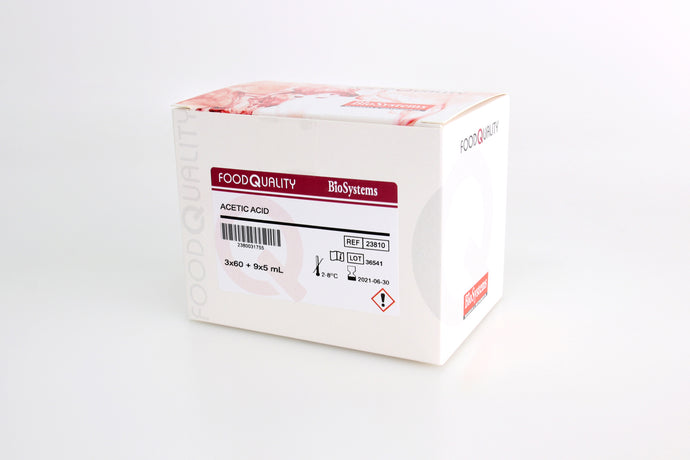 Acetic acid is produced during both alcoholic and malolactic fermentations and helps enhance flavors and aromas. When the wine is aerated or remains in contact with air, acetic acid bacteria can multiply, leading to a problem known as “acetic spoilage”. The characteristic aroma of this spoilage is due to ethyl acetate. Info + Purchase
 -
L-Lactic Acid, reagent kit for wine, kombucha, beer and juice
 L-lactic acid is the product of the metabolism of malic acid during the malolactic fermentation. L-lactic acid is perceived as less acidic and softer on the palate compared to malic acid. Info + Purchase
 -
pH Kit, (3.0 - 4.0)
 In musts and wines the pH varies depending on the ripeness of the grapes, the concentration of organic acids at the time of harvest, the variety of the grape, the presence and metabolism of micro-organisms and the fermentation temperature etc. The appearance of tartrate precipitates during the wine-making process will alter the final pH of the wine. Info + Purchase
 -
Ion Multical
 IONS MULTICAL. 5 levels with 10 mL. Multiparameter calibrator with five synthetic matrix liquid levels that contain various metals at adequate concentrations to calibrate the measurement procedures. Info + Purchase
 -
Control Wine, Red
 Control Wine (white and red) is a wine (10 x 5 ml) that contains various components at adequate concentrations for quality control in laboratories. The product is designed for intra-laboratory quality control and is supplied with acceptable value intervals. Info + Purchase


- Previous page
- Page 2 of 5
- Next page